POS Loan or Business Loan: A Complete Comparison Guide
Choosing the right financing option is an important decision for any business in the UAE. It matters most when you manage cash flow or plan for growth. Among the several loan options available in the UAE, POS loans and business loans are most commonly used. However, people often confuse them or use them as the same thing.
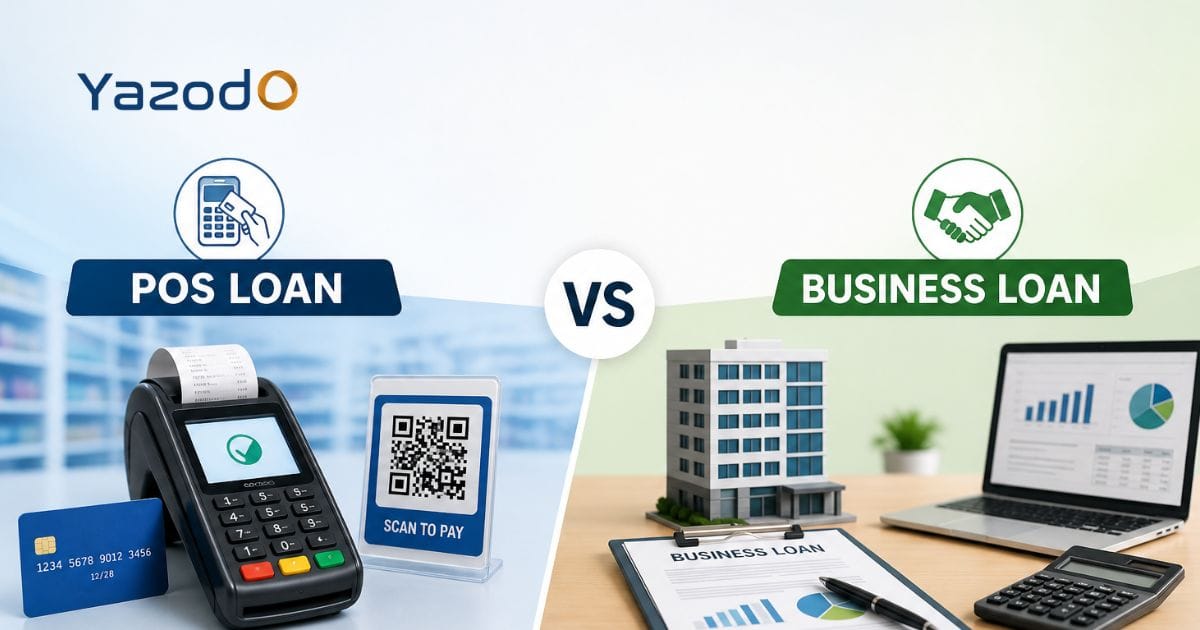
POS loans and business loans are structured quite differently. A POS loan is typically linked to a business’s card sales, where repayment is deducted directly from POS transactions or structured based on the business’s sales performance. However, in the UAE, repayments are often made through fixed monthly instalments or frequent automated deductions rather than purely flexible, sales-adjusted payments.
In contrast, a traditional business loan follows a fixed repayment schedule with set monthly instalments and is generally used for larger or long-term financial requirements.
The following “write-up” explains the difference between a POS loan and a business loan in the UAE. It helps you avoid extra financial pressure and choose a solution that fits your business model, cash flow, and growth plans.
Call us or share your details for a free eligibility check.
Call us or share your details for a free eligibility check. Our trusted advisors will guide you through every step with full clarity and transparency.
Request A Call Back
What Is a POS Loan in UAE?
A Point of Sale (POS) loan is a type of business financing designed for merchants that accept card payments through POS machines. It is mostly used by retail shops, restaurants, salons, and other service-based businesses with consistent card transaction volumes.
In the UAE, POS loans are typically assessed based on a business’s card sales and overall turnover. While the facility is linked to POS performance, it does not always operate on a fully flexible repayment model. In most cases, repayments are structured as fixed monthly instalments or scheduled deductions, which are calculated based on the business’s historical POS transactions and cash flow.
Unlike traditional business loans, where eligibility is heavily based on financial statements and credit profiles, POS loans focus more on transaction history and sales consistency, making them accessible for businesses with strong card revenues.
Key Features of a POS Loan (UAE):
- Linked to POS transaction history and business turnover
- Repayment is usually through fixed monthly instalments or structured deductions
- Faster approval process compared to traditional business loans
- Eligibility primarily based on card sales performance
- Commonly used for short-term working capital needs
This type of financing is particularly useful for SMEs in the UAE that have strong and stable POS transactions, as it provides quicker access to funds with repayment structures aligned to their business capacity.
What Is a Business Loan in UAE?
A business loan is a type of financing provided by banks and financial institutions to help businesses operate and expand. This loan differs from POS-based financing. It has a fixed repayment period. It is more predictable but less flexible.
A business loan can be used for things such as expansion, hiring new staff, managing day-to-day expenses, purchasing inventory, or more. Any company located on the mainland or in any region can apply for a business loan, provided business meets the lender’s requirements.
Key Features of a Business Loan:
- Fixed monthly repayments (EMIs) over a defined tenure
- Available as secured or unsecured financing
- Higher loan amounts compared to POS loans
- Requires proper documentation such as trade license, bank statements, and financial records
- Eligibility based on business performance, cash flow, and credit profile
In the UAE, business loans usually suit companies with steady revenue and a clear financial record. Lenders review repayment ability before approving the loan.
Call us or share your details for a free eligibility check.
Call us or share your details for a free eligibility check. Our trusted advisors will guide you through every step with full clarity and transparency.
Request A Call Back
Benefits of POS Loan
- Repayments are structured based on POS transaction history, usually through fixed monthly instalments or scheduled deductions
- Faster approval process compared to traditional financing
- Minimal documentation required
- Ideal for managing short-term cash flow gaps
- Suitable for SMEs with consistent POS transactions
Benefits of Business Loan
- Access to higher loan amounts for larger financial needs
- Fixed repayment structure allows better financial planning
- Suitable for long-term business growth and expansion
- Can be used for a wide range of purposes including working capital and asset purchase
- Builds business credit profile when repaid on time
Both options offer unique advantages, and the choice should depend on how your business operates and your financial goals.
Regulatory Considerations in UAE
When you apply for a business loan or a POS loan in the UAE, get it from a licensed bank or an authorised financial institution. This keeps your business safe. Ensures the loan details are clear and follow local regulations.
Lenders check if your business can repay the loan before approving it. Here’s what they usually look at;
- Your bank statements (last 6–12 months)
- Transaction history and cash flow stability
- Overall financial health of your business
- Credit history or credit score
- Business age and operational track record
- Monthly revenue consistency
- Existing loans or liabilities
This helps them make sure you can pay back the loan and if it is suitable to take loan for your business. It does not matter if your business is in the mainland or a free zone. To get a loan your business must have a valid trade license and must operate within legal guidelines. The lender also tells you about the loan terms, such as the interest rates, fees and how much you need to pay back. Knowing these terms and regulations can help you avoid any charges or misunderstandings about the loan.
Common Mistakes to Avoid
When looking for a business loan, one common mistake that business owners make is choosing a loan only because it gets approved fast. Getting a loan quickly is nice. But, it should not be the only thing you think about when you make your decision.
The second common mistake that most of the applicants make is not fully understanding the repayment structure. Understanding how to pay back the loan is an essential factor. A POS loan may seem easier because of flexible repayments, but if you do not make a lot of money by accepting payments through cards, then deductions can still impact your cash flow. The same thing happens with a business loan that you have to pay in fixed amounts. It can be really hard to pay back if you do not make the same amount of money every month.
Many businesses also do not think about how much it costs to borrow money, including all the extra fees and charges and interest rates. They just think about how much money they are borrowing, not about how it will affect their whole business financially. To avoid this mistake, you must calculate the cost of the loan including all the fees and charges and interest rates in advance.
Before making any decision, always evaluate:
- Your cash flow stability
- Repayment commitments
- Total cost of financing
- Purpose of the loan
Avoiding these mistakes can help you choose the right financing option and maintain financial stability in the long run.
Conclusion
In conclusion, both POS and Business loans are useful financing options for UAE business, but it’s essential to understand that they serve your business needs and circumstances.
When it comes to POS loans, it is more suitable for businesses that depend on daily card transactions and require flexible, short-term funding. On the other hand, business loans are more suitable for companies maintaining steady cash flow. It provides larger amounts of funding to grow or make long-term investments.
Always remember that, if you choose the right, your business can benefit and if you choose wrong, be ready to face unnecessary financial pain.